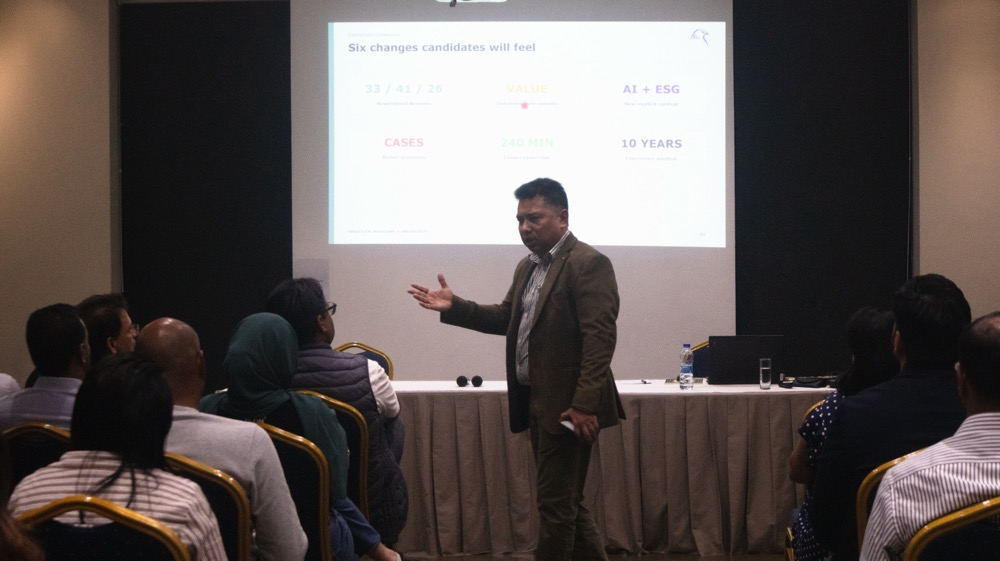
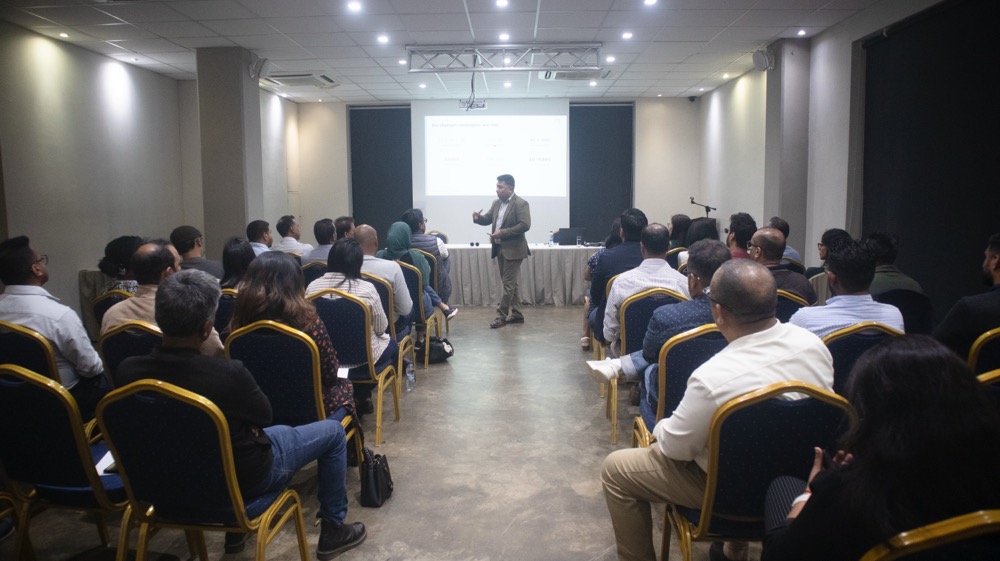
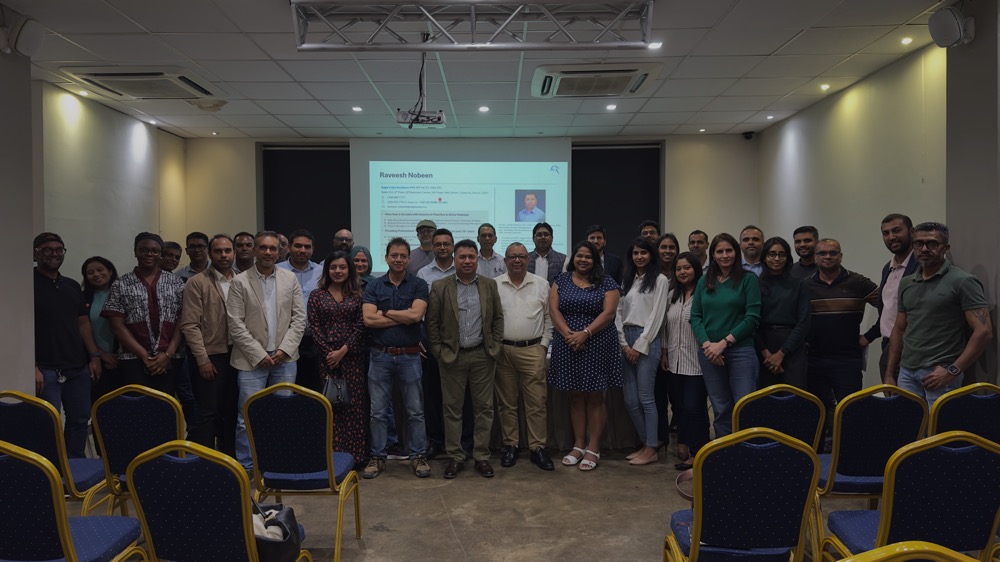
On Wednesday 23 September 2026, more than 35 members and project professionals joined us at Flying Dodo, Bagatelle Mall, for our latest meetup. The topic was one that many in our community have been asking about. The PMP® exam changed on 9 July 2026, and people want to know what it means for them.
Our speaker was Raveesh Nobeen, CEO and Chief Mentor of Eagle's Eye Solutions, a PMI Authorized Training Partner. Raveesh is a certified PMP® and CAPM® instructor, a PhD scholar in project management, and a former Vice-President of Education and Professional Development of our Chapter. He has trained more than 4,000 professionals, so the room was in good hands.
One exam, one credential
Raveesh opened with a simple message. The transition is already complete. The previous exam was last available on 8 July 2026, and the new one went live the next day. There is no "old PMP" and "new PMP". There is only one PMP® certification, assessed through the current exam.
Business Environment moves to the centre
The biggest shift is in how the three domains are weighted. People goes from 42% to 33%. Process goes from 50% to 41%. Business Environment jumps from 8% to 26%, more than three times its previous share.
This means candidates now need solid knowledge of governance, compliance, finance, organisational change and value realisation. The Exam Content Outline now lists 26 tasks, with 8 in People, 10 in Process and 8 in Business Environment.
AI and sustainability are also now explicit parts of the exam. Candidates are expected to use data and tools responsibly while keeping human judgment, and to consider the environmental, social and economic impact of their projects.
Delivery approaches stay mixed across all domains. About 40% of questions are predictive, and the other 60% are split between agile and hybrid. Raveesh's advice was clear. Do not study in silos. First understand the delivery context of a question, then pick the answer that protects value, people and governance.
A longer, more structured exam day
The exam now has 180 questions, of which 170 are scored and 10 are unscored pretest items. Candidates are not told which 10 questions are unscored, so every question deserves your full attention. Candidates get 240 minutes and two 10-minute breaks. It is split into three sections. The first 40 questions form a case study section, followed by two blocks of 70 questions each.
One detail caught the attention of many in the room. Once a break starts, you cannot go back to the previous section. You can only review questions within the section you are in. Raveesh suggested a simple rhythm. Answer the clear questions quickly, flag the uncertain ones, and review your flags before each break. The average pace works out to about 1 minute 20 seconds per question.
Raveesh also stressed that candidates should take both breaks. Some people are tempted to skip them to save time, but he advised against it. Drink some water, have a snack, or take a short walk to clear your mind. Then start the next section fresh.
Two new question formats have been added. Case or scenario sets give a detailed situation followed by several questions. Graphic-based questions ask you to read a chart, diagram or image before answering. These join the existing formats such as multiple response, matching, point-and-click and pull-down lists. The exam now tests interpretation, not just recall.
Already studied? Do not start over
Many attendees had already started preparing before July. Raveesh had good news for them. Earlier training still counts. Core principles, predictive and agile foundations, leadership and risk skills all remain relevant.
What needs updating is the domain weighting, the depth in Business Environment, and practice with the new question formats. Old mock exams and memorisation-heavy habits should be left behind. He also reminded everyone that the PMBOK® Guide is not the exam syllabus. The Exam Content Outline is.
He shared a four-week bridge plan for those updating their preparation. Week one is for reading the 2026 outline and taking a diagnostic test. Week two focuses on closing content gaps in Business Environment, AI, sustainability and finance. Week three builds new habits with case sets and visual questions under time pressure. Week four is for full timed mocks and reviewing reasoning errors.
The new reference guides
Raveesh also walked us through the latest PMI publications. The PMBOK® Guide Eighth Edition, published in November 2025, is built around six principles and seven performance domains. It keeps the foundation of the Seventh Edition but makes the guidance more practical, with added content on AI, PMOs and procurement. The Agile Practice Guide Second Edition, released in July 2026, now reaches beyond teams to the enterprise, covering flow metrics, DevOps, AI and scaling.
His advice was to study from the blueprint outward. The Exam Content Outline tells you what is assessed. The guides help you build the judgment to answer well.
Thank you
The session ended with a lively Q&A. A big thank you to Raveesh for a clear and practical session and to everyone who came along.